No tool in dog training is argued about more than the remote collar, often called the e-collar. Raise it with most trainers and you will hear one of two answers: that it is dangerous and abusive, or that it belongs on every dog. The first answer is by far the more common. What you will rarely hear is a middle position, and rarer still, a firsthand one. This essay is ours: what we use, how we use it, and why.
I did not arrive at the tool easily. When I first entered the world of dog training and dog psychology, I was unsure about it myself. The articles I read described shocking and zapping, and they made me wary. They also read as though they were not telling the whole story, and I prefer to be fully informed about anything I hold an opinion on. So I set out to learn properly. I studied hours of film and attended workshops with some of the most respected trainers in the world, watching the tool used the right way. What I concluded is that in educated hands it is humane, precise, and remarkably effective.
A tool has no intention of its own. A hammer can build a beautiful home; misused, it can do real harm. A knife can prepare a meal or open a box; misused, likewise. Whether a tool builds or damages depends entirely on the hands that hold it and the education behind them. Can a remote collar be used badly? It can. It can also be used with gentleness and skill.
Here are the specifics, because specifics are where honesty lives. We use a collar called the Einstein Mini-Educator. Its dial runs from 0 to 100, and we work at the lowest level the dog can perceive, usually between 3 and 8. Almost every dog we work with has a working level under 10. At those levels the sensation is not a shock and not a zap. It is a faint, fleeting sensation, barely there.
I have worn the collar on my own neck, and I feel nothing at all until the dial reaches 12 or 13, above the level at which nearly every dog works. When a family first hears "e-collar," the reply is often "you mean a shock collar." So we place the collar in their hands at a working level and let them feel it for themselves. The reaction is nearly always the same: "Oh. That's it?"
Every tool we use is tested on ourselves before it ever touches a dog.
The tool's reputation is real, and it was earned, by an older generation of equipment and an older way of using it. The collars of the past ran from 1 to 5, and a 1 on those collars felt like a 20 on today's. They were used for correction only: when a dog misbehaved, the stimulation came high and hard. Dogs trained that way learned fear along with everything else, and the tool's name suffered for it, deservedly. What we do shares a name with that era and nothing else.
Modern low-level conditioning works differently, and the difference is everything. We begin in an environment with zero distractions and find the dog's working level, starting at 1 and rising one number at a time until the dog first notices the sensation: an ear raised, a head turned, a glance upward. That level, barely perceptible, is where we stay. Then we layer meaning onto it. With the dog on leash, we say "come," press the button, and guide them gently back to us with leash pressure and warm praise. Then repetition, in generous volume. Over many sessions the sensation stops being a mystery and becomes a message: return to me. By the end of the process, a dog can be completely reliable off leash, at long distances, amid serious distraction, at levels they barely feel.
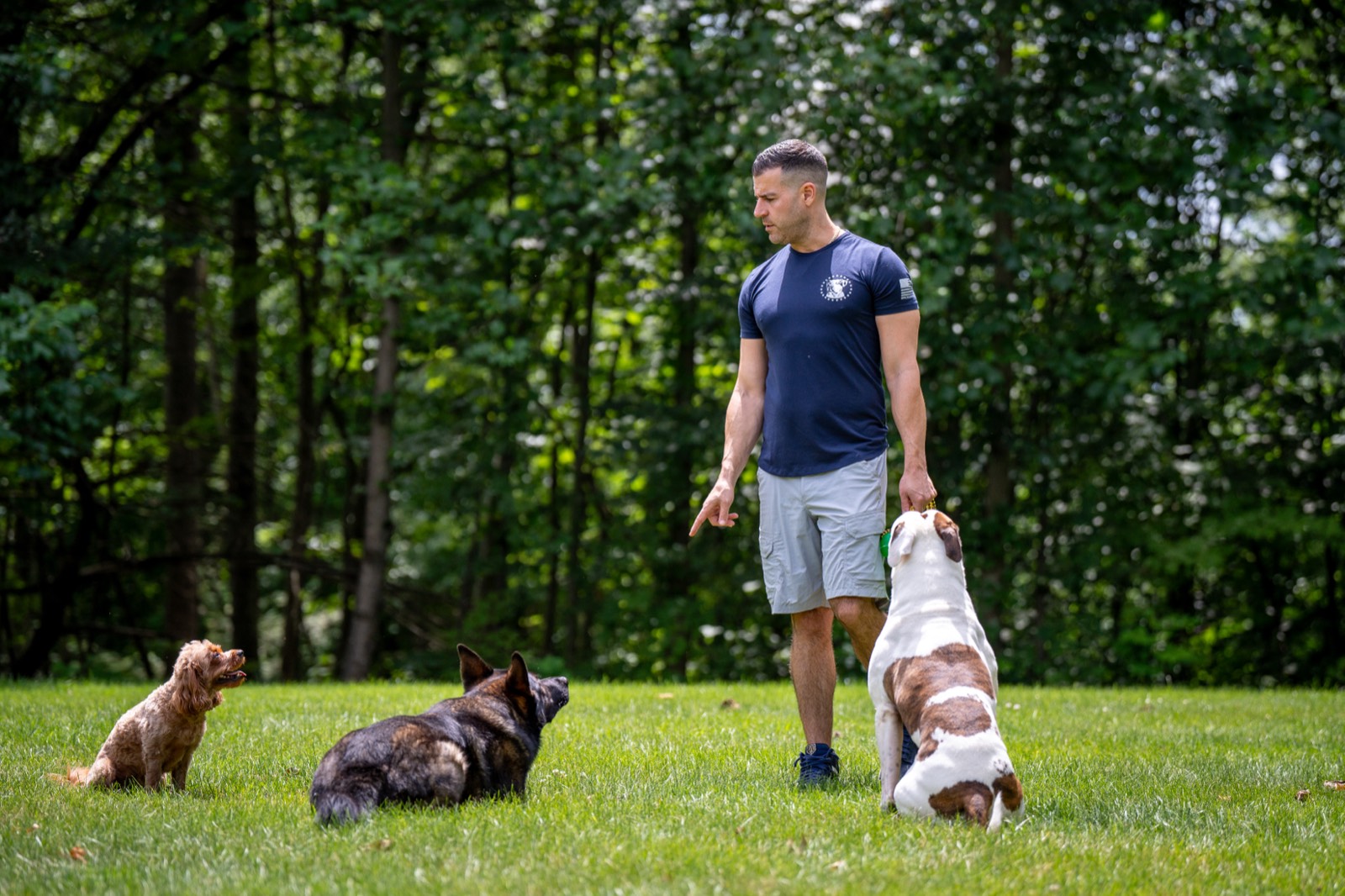
Off-leash reliability is only the beginning of what the tool makes possible. For the dog, it means liberty with safety: the run through the woods, the recall that always works. For the owner, it builds something just as valuable, which is confidence. A person who knows their dog will return is a calmer person, and calm travels straight down the leash, even when there is no leash at all.
Because the tool is powerful, it belongs only in educated hands. We ask that no one use a remote collar without instruction, on film or in person, from a professional experienced in its proper use, and for our own families we are glad to be that instruction. Any family curious about this work is welcome to raise it with us in a consultation.
When you hear the tool described as cruel, one gentle question is fair to ask: what firsthand experience does the speaker have with it? Often the answer describes the collars of decades ago, or no experience at all. We hold ourselves to a single standard on every subject in dog training: form opinions from knowledge, not from feeling. It is the standard we would wish for the whole conversation about dogs.
Further reading: The case for balance, on why reward and guidance belong together.
Discover more